
Growth doesn't always lead to higher profitability, though many service companies continue winning projects, expanding teams, and increasing revenue, yet struggle to improve margins.
The issue is often not demand, pricing, or competition.
Instead, profitability and trust are gradually reduced by operational inefficiencies that go unnoticed during service delivery.
As business growth accelerates, managing projects, people, and financial data through spreadsheets and disconnected systems becomes increasingly difficult.
This is where an ERP system can help by connecting project management, resource planning, invoicing, timesheets, and financial reporting into a unified business management platform.
Why Revenue Growth Doesn't Always Increase Business Performance

Service businesses earn money through expertise, time, and client success. Their profit depends on how well they deliver, track, and bill for projects.
It's reported that only 73.4% of projects are delivered on time, down from over 80% three years ago. Billable utilization stands at 68.9%, below the 75% threshold for healthy profitability.
This indicates that being busy does not equal profit. More projects and larger teams add complexity, making it essential to have the right ERP system and business management software, especially for mid-market businesses.
4 Core Profit Leaks Hurting Your Bottom Line
1.Inaccurate time tracking
For many organizations in the service industry, time is revenue.
Late or poorly recorded timesheets directly lead to unlogged, unbilled hours. Beyond immediate lost revenue, incomplete logs degrade the accuracy of future project costing and business forecasting.
2. Unmanaged project scope
Additional meetings, revisions, and support requests often become part of project delivery.
Without clear project management controls and billing processes, businesses risk delivering more value than they are paid for. Over time, project scope change can significantly reduce project margins.
3.Delayed invoicing
Manual validation chains across disconnected systems stretch billing cycles from days to weeks. For a mid-market firm, this lag directly bloats DSO, locks up essential working capital, and distorts cash flow forecasting.
4.Inefficient resource utilisation
Resource utilization is another vital driver of profitability. Without visibility into workloads and capacity, some employees become overloaded while others remain underutilized. Maintaining healthy utilization rates becomes difficult when planning relies on spreadsheets and disconnected data.
Why Disconnected Systems Fail at Scale
Most service businesses already have the data they need.
The challenge is that project management, accounting, timesheets, CRM, and reporting often exist in separate software. While each one performs its function, they rarely provide a complete picture of business operations.
Project managers see task progress but lack financial context. Finance teams track invoices but lack real-time visibility into active project execution. Hence, executive leadership only views trailing revenue performance rather than real-time profitability.
Without connected data, it becomes difficult to answer important questions:
Which projects are most profitable?
Where is revenue leakage occurring?
Are resources being utilized effectively?
How accurate are project estimates?
How can business operations be improved?
The problem is not a lack of information, but it is a lack of visibility.
For example, we worked with an insurance firm, Tenzing Pacific Services, experiencing similar challenges due to rapid expansion. They decided to switch from 4 standalone systems (WordPress, HubSpot, Mailchimp & Google Sheets) to only one, Odoo ERP. This transition allowed the company to manage their leads, quotations, projects, and resources efficiently during the pandemic.
Unified Operations via ERP Solution
Modern ERP software helps service businesses streamline operations, automate routine tasks, and improve decision-making through real-time visibility into projects, resources, and financial performance.
For service companies, this creates several advantages:
1. Real-time project profitability tracking
Many service businesses only discover margin issues after a project is completed or month-end reports are finalized. An ERP system provides continuous financial visibility throughout the project lifecycle.
The Odoo Solution: Odoo utilizes Analytic Accounting to track project financials in real-time. Each project can have its own analytic account, which automatically allocates costs and revenues.
The Impact: Project managers can monitor project profitability and margins continuously, rather than waiting until the month closes.
2. Integrated time tracking and billing
Manual timesheet collection and invoice preparation often create delays that impact cash flow and increase the risk of missed billable hours.
The Odoo Solution: It connects consultants' Timesheets directly to Sales Orders.
The Impact: Draft invoices are automatically generated based on actual Time & Material (T&M) services delivered. This accelerates the billing process, improves accuracy, and significantly reduces the risk of delayed invoicing.
3. Better resource planning and workflow management
Effective resource allocation depends on having clear visibility into team capacity and project demands.
The Odoo Solution: It replaces manual resource planning spreadsheets with a centralized, visual scheduling tool.
The Impact: Managers can instantly see team availability, balance workloads, and assign resources more effectively, leading to better utilization and smoother project delivery.
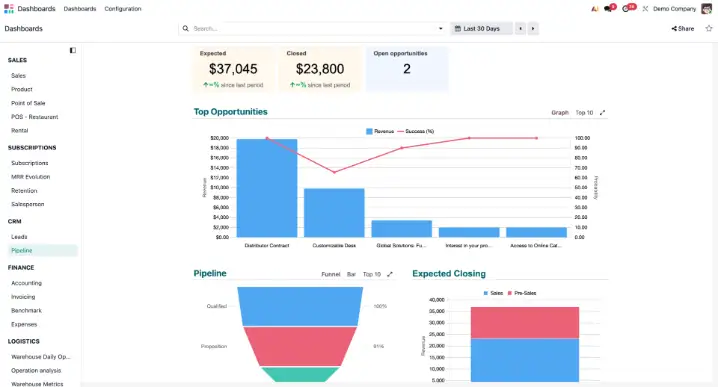
4. More reliable forecasting and business intelligence
Accurate forecasting fails when your CRM, project management, and accounting tools live in disconnected silos.
The Odoo Solution: It unifies your entire pipeline into a single, integrated platform.
The Impact: Sales opportunities in the CRM help estimate future revenue and cash flow, while Odoo’s dashboards compare planned costs to actual costs from timesheets, expenses, and invoices. This provides instant visibility into financial performance, reducing manual Excel reconciliation and enabling quicker, data-driven decisions.
Choosing the Right ERP Software for Professional Services
Not all ERP systems are designed for the same business needs.
Service businesses require different capabilities, including project delivery, resource planning, CRM, time tracking, invoicing, and financial reporting.
When choosing the ideal ERP system, organizations should evaluate how well the platform supports their workflow, service delivery model, and long-term business growth goals.
Core features of ERP software for service businesses include:
Project management
Resource planning
Timesheet
CRM
Financial management
Workflow automation
Business intelligence
Why Odoo is a strong fit for service businesses
Odoo brings project management, CRM, timesheets, resource planning, accounting, and invoicing together in a single platform, giving teams a unified view of their operations.
Its modular design allows businesses to start with the applications they need and expand as they grow, while adapting to unique business processes. This combination of flexibility, scalability, and affordability makes Odoo a practical ERP solution for growing service businesses.
The Specialised ERP Solution Helps Transform Your Business
As service businesses continue to grow, visibility becomes more than a reporting advantage; it becomes the foundation for sustainable profitability.
With the right ERP solution and an experienced implementation partner, you can move beyond disconnected systems and make decisions with confidence. Operations teams gain better control over project delivery and resource allocation.
Finance teams benefit from faster billing, more accurate forecasting, and real-time profitability insights. Project managers can monitor budgets and project margins throughout delivery, while HR and resource managers gain clearer visibility into team capacity and utilization.
Instead of spending valuable time reconciling spreadsheets and chasing information across multiple systems, leadership can focus on improving project performance, protecting margins, and supporting long-term business growth.
Discover how our ERP solution specilised for service industry today.